 How-to
Are Trapping Lures Effective in Winter Hunting?
Last Updated: November 22, 2026
Quick Summary
Trapping lures are effective for winter hunting when you match the lure's scent profile and carrier to cold conditions, since cold air and frozen ground slow scent travel. Oil-based paste lures hold scent well below freezing, while thin liquid lures flash off quickly. Build your winter lineup around two or three lures and refresh them on a schedule tied to temperature.
- Oil-based paste lures resist freezing and work in deep cold, but release scent more slowly.
- Refresh lure after a hard freeze, fresh snow, or a warm spell rather than on a fixed calendar.
- Over-applying is the most common winter error, creating an unnatural concentration that spooks wary animals.
- Rotate scent families every two to three weeks or after a weather event to reset novelty for conditioned animals.
- A catch log with date, target caught, non-target species, and conditions reveals selectivity patterns within a few weeks.
Table of Contents
- Are trapping lures effective for winter hunting?
- Best trapping lures for cold weather
- How to use trapping lure so it keeps working below freezing
- How to avoid non-target catches when trapping
- Equipment for setting traps along a stream
- Matching lure and set to the target species
- Common winter lure mistakes to avoid
- Choosing your winter lure lineup from Campbell Fine Furs
- Frequently Asked Questions
Are trapping lures effective for winter hunting?
Yes, trapping lures are effective for winter hunting, but only when you match the lure's scent profile and carrier to cold conditions. Cold air and frozen ground slow scent travel, so a lure that performs well in October often goes quiet in January.
Here's what most guides get wrong: they treat winter as a single season. It isn't. A 25-degree morning with crusted snow behaves nothing like a 10-degree morning after a thaw-freeze cycle, and your lure choice has to reflect that difference.
The good news is that winter trapping rewards a narrow, disciplined approach. You need fewer lures than you think, applied with better timing.
Best trapping lures for cold weather
Oil-based and paste lures with heavy, low-volatility scents are generally better suited to cold air than thin liquid lures, which can flash off quickly.
Scent profiles and temperature performance
Scent families behave differently as the mercury drops. Here is how the main categories stack up:
| Lure Type | Scent Profile | Cold-Weather Performance | Best For |
|---|---|---|---|
| Oil-based paste | Heavy, long-lasting | Holds scent well below freezing | Dirt hole sets, cold snaps |
| Gland-based liquid | Sharp, musky | Moderate; needs frequent refresh | Fresh sets, moderate cold |
| Food-based bait | Sweet or savory | Weak scent throw in cold air | Draw sets near cover |
| Curiosity lure | Mild, unusual | Low; best as a secondary note | Sets with heavy competition |
Pros and cons of each lure type
Oil-based paste
- Pros: Long shelf life at the set, resists freezing, works in deep cold
- Cons: Slower to release scent, harder to apply with heavy gloves
Gland-based liquid
- Pros: Strong, immediate scent throw, good for fresh sets
- Cons: Needs refreshing more often, can freeze at the applicator tip
Food-based bait
- Pros: Reliable draw, works well near cover and travel routes
- Cons: Weak scent carry in cold air, attracts non-target animals more readily
Curiosity lure
- Pros: Adds a second layer of interest to a set
- Cons: Not a standalone draw in winter, easy to overuse
A common mistake is buying one lure and expecting it to do everything. In practice, a paste for staying power plus a gland lure for punch covers most winter situations.
How to use trapping lure so it keeps working below freezing
To keep trapping lure working below freezing, apply it in small amounts to a sheltered spot and refresh it on a schedule tied to temperature, not to your calendar. Lure that freezes solid or gets buried in snow stops working entirely.
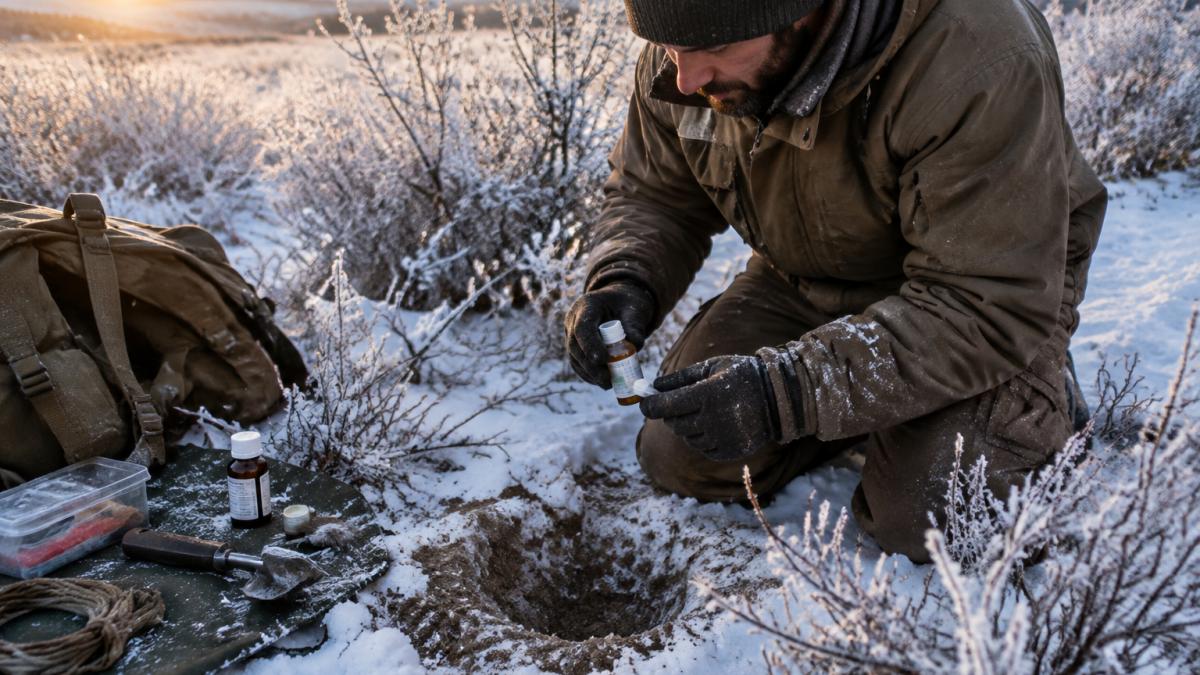
Placement and refresh timing at a winter set
Placement matters more in winter than in fall. Put lure where it stays out of direct wind and won't fill with snow. A small depression, a natural pocket under a root, or the lip of the dirt hole all work.
Refresh timing should follow the weather:
- After a hard freeze: check and refresh, because ice can seal the lure in
- After fresh snow: clear the set and reapply, since snow buries scent
- After a warm spell: refresh sooner, because thaw cycles degrade paste fast
- On a stable cold stretch: a light refresh every few days is usually enough
Watch out: over-applying is the most common winter error. Too much lure in cold air creates a strong, unnatural concentration that spooks wary animals. A small dab goes further than you'd expect.
How to avoid non-target catches when trapping
You avoid non-target catches by narrowing your set's appeal: use species-specific lures, size your traps to your target, and place sets where the intended animal travels. A set that smells interesting to everything will catch everything.
In trapping, a non-target catch is any animal you didn't intend to take.
Species-specific lure attributes that reduce bycatch
Most practitioners find that bycatch drops when lure attributes are chosen for the target's senses rather than for maximum odor. The four levers are size, color, action, depth, and scent:
Safe handling and release of non-target animals
When a non-target animal is caught, the goal is a fast, low-injury release. A common pattern among experienced trappers and anglers:
- Approach calmly and cover the animal's eyes or head with a cloth to reduce stress.
- For traps, release the animal on-site if state rules allow; use a release tool or open the trap away from your body.
- For hooked fish, use a net to support the body, back the hook out with pliers, and keep the fish in the water as much as possible.
- If a hook is deep, cut the line close to the hook rather than tearing tissue; many hooks corrode or pass.
- Wet your hands or gloves before handling fish to protect their slime coat.
- Release into calm water away from your set so the animal doesn't immediately re-enter the catch zone.
Watch out: state regulations on releasing trapped wildlife vary widely, and some species cannot be released legally once captured. Check your state wildlife agency's rules before the season, not after an accidental catch.
Measuring selectivity with a simple catch log
You can't improve selectivity you don't measure. A basic log with four columns, date, target caught (yes/no), non-target caught (species), and conditions (temperature, snow, water clarity), takes a minute per check and reveals patterns within a few weeks. Most practitioners find that two or three lure/set combinations account for most of their non-target catches, which makes the fix obvious.
Scent control and camouflage around the set reduce accidental encounters too. Our DIY trap camouflage and scent control field guide walks through the practical steps.
Equipment for setting traps along a stream
Stream banks are one of the trickiest winter locations. Water levels shift, ice forms at the edges, and soft ground makes anchoring unreliable. Bring the right kit and you'll spend less time fixing sets.
What belongs in the pack:
- Traps matched to your target species and the bank conditions
- Lure in sealed, waterproof containers
- Stakes or anchors long enough for soft soil
- A small trowel or digging tool
- Scent-free gloves and a separate bag for gear
- A towel or rag for drying hands and tools
Our complete trapping supplies guide covers how these pieces fit together for a full winter kit.
Matching lure and set to the target species
Match lure and set to the target species by choosing a scent that species responds to and building the set around its travel and hunting habits. A lure that pulls one animal strongly may barely register with another.
Species respond to different scent cues, and the set type should follow.
| Target | Preferred Lure Family | Set Type | Winter Adjustment |
|---|---|---|---|
| Red fox | Gland-based liquid, sharp musk | Dirt hole, flat set | Refresh after freeze; fox travel routes shift with snow depth |
| Coyote | Oil-based paste plus gland note | Dirt hole, scent post | Paste holds in deep cold; place where wind carries scent across travel corridor |
| Raccoon | Food-based bait, sweet | Cubby, pocket set | Weak scent throw in cold; place near denning cover |
| Bobcat | Curiosity lure plus gland | Trail set, cubby | Low scent output in cold; rely on visual and curiosity triggers |
| Mink | Gland-based liquid, fishy note | Bank set, cubby near water | Keep lure above ice line; refresh after thaw cycles |
Seasonal, location, and habitat considerations
Winter changes where animals travel, and the set has to follow. Snow depth pushes some animals onto packed trails; ice formation on streams concentrates mink and raccoon activity at open-water edges; and cold snaps push predators to sheltered south-facing slopes. A lure that works on a dry ridge in October may need a different placement when that ridge is drifted over.
Water clarity and depth matter for the fishing side of the same problem. In clear winter water, fish can inspect a lure before committing, so natural colors and slower actions reduce non-target takes. In stained or high water, darker profiles with a single flash point are easier for the target to find without broadcasting to everything.
Rotating scents for pressured and conditioned animals
Pressured or conditioned animals that have learned to avoid certain scents will ignore a lure that worked earlier in the season. Rotating between scent families, gland to food-based to curiosity, resets the novelty without abandoning the set. A common pattern is to rotate on a two-to-three-week cycle or after a weather event that changes travel patterns.
If you're new to winter sets, our beginner's guide to trapping lure effectiveness covers the fundamentals before you spend on a full lineup.
Common winter lure mistakes to avoid
The biggest winter lure mistake is treating cold weather like a minor version of fall. Cold changes how scent moves, how long it lasts, and how animals respond. Ignoring that shift costs you sets.
Here are the errors we see most:
- Using a summer lure in deep cold. Thin, volatile lures vanish in cold air.
- Over-applying. More lure isn't better; it's a warning signal to wary animals.
- Skipping refreshes after weather changes. Freeze and thaw cycles degrade lure fast.
- Setting where snow will bury the lure. Placement out of drift zones matters.
- Using broad-appeal scents. They pull in everything, including non-target animals.
- Not rotating scents. Conditioned animals learn to avoid a repeated cue.
Get these right and your winter sets will outperform most of the sets around you.
Choosing your winter lure lineup from Campbell Fine Furs
Build your winter lineup around two or three lures, not ten. Start with an oil-based paste for staying power, add a gland-based liquid for a sharper note, and keep one curiosity lure as a secondary layer. That trio covers most cold-weather situations.
At Campbell Fine Furs, our Western lures are made with Andy Weiser's formulas, which were built for real winter conditions rather than mild-weather use. You can see the full lineup, including the Rocky Mountain Rub Lure, on our product pages. If you're still comparing scent families, our field guide to Western hunting lures breaks down what each profile does best.
Winter trapping doesn't require a huge arsenal. It requires the right few lures, applied with discipline and refreshed on schedule. That's the difference between a season of empty sets and one worth remembering.
Winter sets punish guesswork. The trappers who do well aren't the ones with the most lures; they're the ones who match scent to conditions and keep their sets working through the cold.
Frequently Asked Questions
What is one way you can avoid capturing pets and other non-target animals?
Set traps away from trails, fence lines, and yards where pets travel, and check your sets often. Check local regulations on trap placement near public access, and check your sets often so anything caught accidentally can be released quickly.
What makes trapping lures effective in winter?
Cold air holds scent poorly and frozen ground locks odors in place, so the lures that work in winter are the ones with strong, stable bases like gland, urine, and fish oil that keep releasing scent at low temperatures. Placement matters as much as the formula: put lure where it stays slightly protected from wind and snow, and refresh it more often than you would in fall.
How often should you refresh trapping lure in cold weather?
Plan on checking and refreshing lure every few days in deep cold, and after any snow, ice, or rain event. Freezing temperatures slow evaporation, but snow burial and ice glaze can seal a lure so it stops carrying. Carry a small bottle and top up the set during your regular trap check rather than making a separate trip.
How do you choose a lure for a specific target species?
Match the lure to the target species where you can, and keep the lure dose small.