 listicle
Why Heirloom Quality Fur Throws Are Worth the Investment
Last Updated: November 6, 2026
Quick Summary
Heirloom quality fur throws are worth buying because good construction keeps them warm, shapely, and comfortable for a decade or more. Their cost per year of use is often lower than that of cheaper throws replaced every few seasons.
- Check the backing for a tight, flexible base that does not pull away from the pelts.
- Part the pile to confirm dense fur that covers the backing evenly, with little visible skin.
- Divide total cost, including maintenance and repair reserve, by expected years of service.
- Brush gently in the direction of the pile and store the throw in a breathable cotton bag.
Table of Contents
- What Heirloom Quality Means for a Fur Throw
- Benefits of Investing in Heirloom Quality Fur Throws
- Natural Fur vs. Faux Fur Throws: How to Choose
- How to Style a Fur Throw in a Rustic Bedroom or Living Room
- Fur Throw Blanket Care, Storage, and Repair
- Choosing Your Heirloom Fur Throw from Campbell Fine Furs
- Frequently Asked Questions
What Heirloom Quality Means for a Fur Throw
Heirloom quality describes a fur throw built to be used for decades and passed on, not replaced in a few seasons. It comes down to how the piece is constructed, how dense the pile is, and whether the skins were handled with care from the start.
A throw that feels soft in the shop can still fall apart after a few winters. Loose stitching, thin backing, and sparse pile are the usual signs. Those problems show up early, so the quality is worth checking before you buy.
How to Check Construction and Pile Density
Start by examining the backing. A sound throw has a tight, flexible backing that does not pull away from the pelts when you flex it gently. Look closely at the seams and stitching. Even, close stitching holds up far better than long, uneven runs that loosen with use.
Next, check the pile. Part the fur with your fingers and look at the base. Dense pile covers the backing evenly, with little visible skin between the hairs. Sparse pile thins quickly and looks worn after a few years of normal use. Press the throw and let go. Compare how fur textures and pile densities differ before you decide. Dense fur springs back to its shape, while weak fur stays flattened.
Benefits of Investing in Heirloom Quality Fur Throws
The main benefit is that a well-made throw can deliver the same comfort year after year. Quality construction is generally what keeps a throw from compressing, shedding heavily, or losing its shape as quickly as cheaper pieces.
Warmth, Weight, and Breathability
Dense natural hair can trap air close to the body, which helps it retain heat. A well-made throw feels substantial without being bulky. Weight matters too. A throw that is too light offers little warmth, while one that is too heavy can feel stifling over a bed or sofa.
Breathability is often overlooked. Natural fibers can allow moisture to escape in general, which may reduce the clammy feeling some synthetic covers produce. A practical way to judge it is to hold the throw against your forearm for a minute: a quality piece warms gradually and does not feel wet or plasticky. Drape it over a chair back for an hour and then touch the underside, if condensation or a cold, slick feel develops, the backing is trapping moisture rather than moving it.
Lifetime Cost and Value Per Year of Use
Looking at the price alone can be misleading. A throw that lasts ten or more years costs far less per year of use than one replaced every two seasons. The honest way to compare is to divide the total cost by the number of years you expect to use it, and then add the costs most buyers forget: cleaning, storage supplies, and small repairs.
A workable framework has four lines:
- Purchase price. What you pay up front, including any delivery or handling charges quoted by the seller.
- Expected service life. Be conservative and base the estimate on how the piece is cared for and used.
- Maintenance. Professional cleaning at the intervals the maker recommends, plus brushes, a breathable storage bag, and pest deterrents.
- Repair reserve. A small annual set-aside for seam repairs or lining replacement.
Divide the total of those four lines by the years of service life and you have a defensible cost per year. The comparison only holds if the piece is actually maintained. A neglected heirloom throw can cost more per year than a throwaway.
Ask what cleaning interval the maker recommends and whether repairs are supported before you accept any per-year figure.
Pricing depends on the piece, quantity, and delivery details, so check Campbell Fine Furs's website for current prices or a quote.
The article's key points on value and lifetime cost, summarised for quick reference.
| Factor | What the article says | Note |
|---|---|---|
| Lifetime cost | Divide total cost by years of use | Ten or more years costs less per year |
| Purchase price | What you pay up front | Include delivery or handling charges |
| Expected service life | Base on care and use | Be conservative in the estimate |
| Maintenance | Professional cleaning at maker's interval | Add brushes, storage bag, pest deterrents |
| Repair reserve | Small annual set-aside | Covers seam repairs or lining replacement |
| Warmth | Dense hair traps air near the body | Feels substantial without being bulky |
| Breathability | Natural fibers let moisture escape | Test by holding against forearm |
Natural Fur vs. Faux Fur Throws: How to Choose
Natural fur and faux fur each suit different buyers. Natural fur offers a warmth and texture that many people value. Faux fur costs less up front and avoids animal sourcing questions entirely. Neither choice is wrong. The right one depends on what you value most, but the decision is easier when you replace the vague labels with checkable criteria.
Sourcing, Traceability, and Responsible Ownership
If you choose natural fur, ask where the skins come from and how they were processed. Be cautious of vague answers about sourcing. Traceability matters both for your peace of mind and for how the piece is treated over its lifetime.
A useful checklist for the conversation:
-
Species and origin. Which animal, and from which region or farm? A seller who cannot name the species is not a traceable seller.
-
Processing and finishing. Were the skins dressed by a specialist tannery? Dressing quality drives softness, odor, and how the pelt ages.
-
Documentation. Ask the seller whether invoices or records can connect the finished throw to the skins.
-
Regulatory context. Check that the product carries the label required by applicable U.S. fur labeling rules, and consult the Federal Trade Commission's official guidance for current requirements. A compliant label is a minimum standard, not a guarantee of quality.
Responsible ownership also means planning for the piece's whole life: professional cleaning, proper storage, and repair rather than disposal.
Shedding, Allergies, and Indoor Air Considerations
Some buyers worry that fur sheds heavily or aggravates allergies. A well-made throw generally sheds less than a poorly made one, especially when the pile is dense and well anchored. If you have allergies or pets, brush the throw regularly and keep it off bedding you wash rarely. Consider how often you will handle it before deciding.
A practical household test before you buy:
- Loose-fiber check. Rub the pile firmly with a light-colored cloth. A few hairs are normal; a visible clump means the fur is poorly anchored.
- Odor check. Natural fur should smell neutral. A sharp or musty smell can indicate incomplete dressing or damp storage.
- Pet interaction. Cats in particular treat fur throws as prey. If your household includes cats, plan to store the throw out of reach when it is not in use.
- Sensitivity test. People with known animal-hair sensitivities should handle the throw against bare skin for several minutes before committing, and should keep it out of bedrooms if symptoms appear.
How to Style a Fur Throw in a Rustic Bedroom or Living Room
A fur throw works best as a focal accent rather than a background filler. Drape it over the arm of a leather armchair or across the foot of a bed where the texture can be seen and touched. Pair it with natural materials like wood, stone, and wool to reinforce a rustic look.
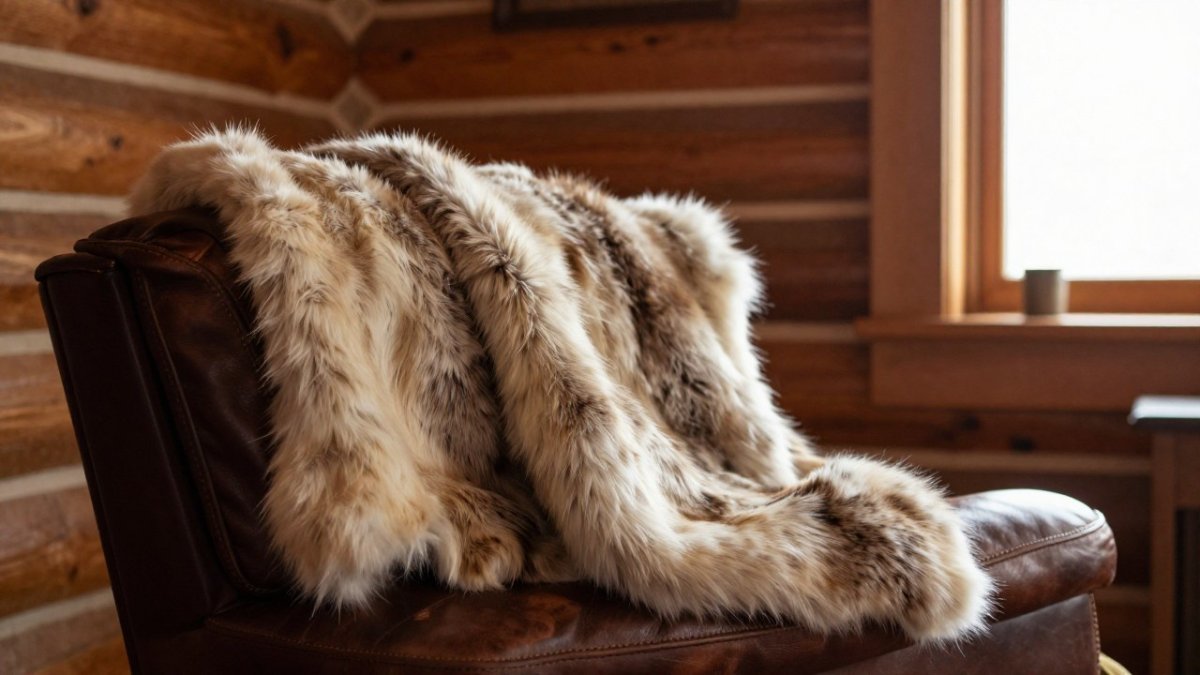
Keep the color palette warm and restrained. Cream, tan, and deep brown work well with log, timber, and iron finishes. Let the throw be the softest element in the room so it draws the eye and invites use.
Fur Throw Blanket Care, Storage, and Repair
A fur throw lasts when it is cared for deliberately. Routine attention matters more than occasional deep cleaning. Understand why well-made artisanal accessories last longer. Brush the pile gently, rotate the throw so wear is spread evenly, and keep it away from direct heat and damp.
Gentle Cleaning and Grooming
Brush in the direction of the pile with a soft brush. Learn what happens when real fur gets wet and how to clean it safely. Avoid harsh scrubbing, which can loosen the base. For spot cleaning, use gentle methods and test any product on a hidden area first. When in doubt, ask a professional who handles fur rather than risking damage at home.
Long-Term Storage and Restoration
Store the throw in a breathable cotton bag, never sealed plastic, and keep it in a cool, dry closet. Check periodically for dryness or signs of wear, and address small problems early. Light repairs to loose seams are far cheaper than restoring a neglected piece.
Choosing Your Heirloom Fur Throw from Campbell Fine Furs
Campbell Fine Furs offers a range of fur accessories, including hats, scarves, and mittens, along with blankets and pillows for the home. Look at the backing, check the pile density, and compare the options against how you plan to use the piece.
Browse the full collection to find a throw that fits your room and your long-term plans. View All Products
Frequently Asked Questions
Are fur throws worth investing in?
They can be, when the construction is sound. A well-made throw with a dense backing and tightly anchored pile tends to hold its shape and softness for many years, which spreads the purchase price across far more seasons than a cheaply made throw that sheds or flattens after one or two winters. Cost per year of use is the most useful way to compare. Pricing depends on material, size, and construction, so check Campbell Fine Furs' website for current prices or request a quote before deciding.
What makes a blanket heirloom quality?
Heirloom quality usually comes down to four things: a dense, evenly anchored pile that resists thinning, a sturdy backing that does not separate from the fibers, careful finishing at the edges, and materials chosen for durability rather than appearance alone. A throw that holds its shape after repeated use and can be cleaned gently without losing texture is the practical test. Ask about construction details before buying, and look for a seller willing to describe how the throw is made.
How do you care for a fur throw so it lasts?
Brush the pile gently with a soft brush in the direction of the grain to lift matted fibers. Spot clean small stains promptly with a mild, cold-water solution and test an inconspicuous area first. Avoid high heat, wringing, and direct sunlight, which can dry out and weaken fibers. Store the throw folded loosely in a breathable cotton bag rather than sealed plastic, and keep it away from pests. Always follow the care instructions supplied with your specific throw.
Are faux fur throws durable enough for everyday use?
Faux fur can be durable for everyday use when the pile is dense and the backing is well made. Lower-quality faux fur tends to shed, pill, and flatten within a season or two. Check the pile density, the stitching at the edges, and how the fibers are anchored. Because both real and faux fur need gentle handling, the care routine matters as much as the material for how long either one lasts.