 how-to
How to Tell Real Fur From Synthetic: A Step-by-Step Guide
Last Updated: November 9, 2026
Quick Summary
To tell real or synthetic fur apart, start by inspecting the backing: real fur sits on a leather hide with pores or grain, while synthetic fur sits on an even woven cloth or plastic mesh. Then check the follicle pattern, hair tips, and feel, and confirm with the label and seller documentation.
- Turn the piece over first; leather backing with pores or grain points to real fur.
- Real fur grows from irregular follicle clusters, while synthetic fibers are tufted in uniform rows.
- Real guard hairs taper to a fine point; synthetic fibers are usually cut blunt or rounded.
- Real fur feels dense and springy at the roots, while synthetic feels uniformly slick.
- Ask the seller for the original label, receipt, or appraisal, since a written fiber statement beats any home test.
Table of Contents
- Start With the Backing: Real Fur Backing vs Synthetic Fur Backing
- Check the Hair Base and Follicles
- Fur Identification by Touch and Appearance
- Look at the Hair Tips: Tapered vs Blunt Ends
- Safe Ways to Identify Fur Without a Burn Test
- How to Tell If a Vintage Fur Coat Is Real
- Reading Labels and Next Steps for Your Own Piece
- Frequently Asked Questions
Start With the Backing: Real Fur Backing vs Synthetic Fur Backing
The backing is the fastest place to start when judging real or synthetic fur. Turn the piece over and look at the base before you look at the hair.
Real fur sits on a leather hide. The leather is usually thin, a little uneven, and has visible pores or small grain marks. It feels soft but firm when you press it.
Synthetic fur sits on a woven fabric or plastic mesh. The backing looks uniform, almost too clean. It often has a printed or stitched pattern that repeats.
- Real fur: leather backing with pores, wrinkles, or grain
- Synthetic fur: cloth or mesh backing with even weave
- Real fur: backing stiffens slightly when bent
- Synthetic fur: backing stays flexible and smooth
Watch out: Do not rely on the backing alone. Some faux pieces use leather-look backings, so check the hair too.
Check the Hair Base and Follicles
Part the fur gently with your fingers. Look at where each hair meets the skin.
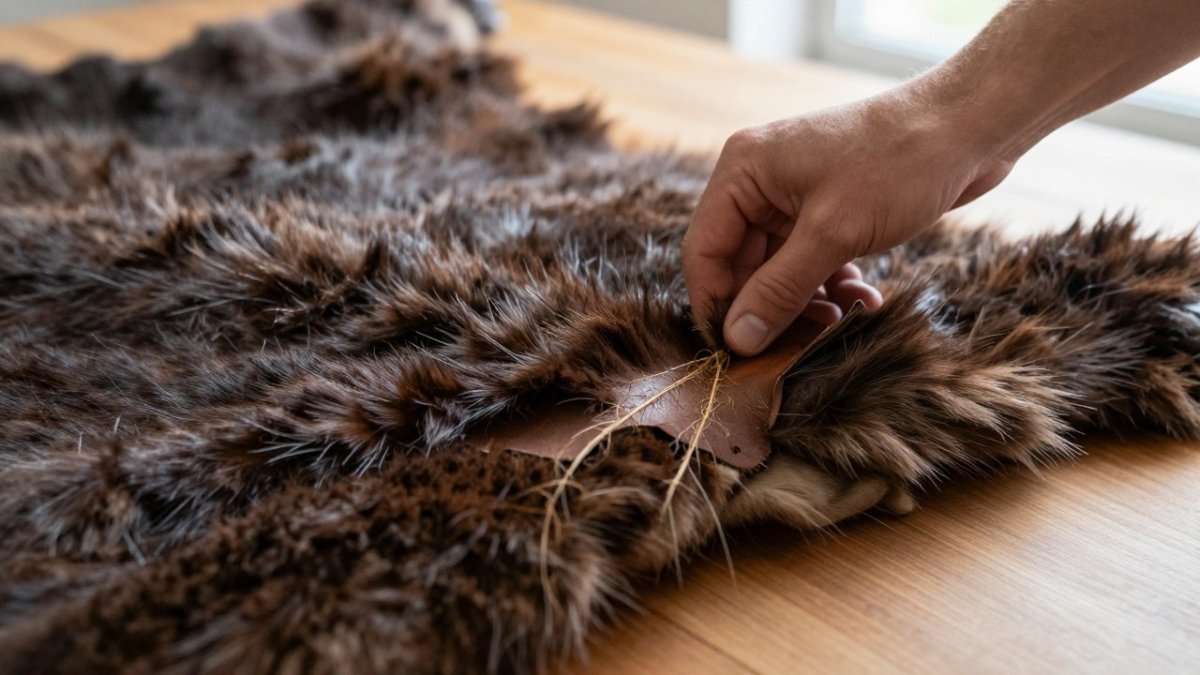
Real fur grows from individual follicles. You will see small clusters of hair with a slight natural variation in thickness. The roots look organic, not perfectly spaced.
Synthetic fibers are often tufted into the backing in rows. The roots look uniform, and the hairs may appear to come from a single line or grid.
Fur Identification by Touch and Appearance
Touch tells you a lot when comparing real or synthetic fur. Real fur feels dense at the roots and softer toward the tips. It has a slight springiness, and the hairs move independently.
Synthetic fur often feels uniformly soft across the whole surface. The fibers can feel slick or static-prone, and they may all move together.
Appearance matters too. Real fur has depth and shifts in color as you move it. Faux fur tends to look flat under bright light.
Look at the Hair Tips: Tapered vs Blunt Ends
Hold a few hairs between your fingers and look closely at the tips. Real guard hairs usually taper to a fine point. Underfur tends to be fine and soft.
Synthetic fibers often end in blunt, cut, or rounded tips. Some look like uniform strands with no taper at all.
A common mistake is checking only one hair. Look at several from different areas of the piece before deciding.
Safe Ways to Identify Fur Without a Burn Test
Many guides recommend a burn test, but it can damage a garment if done carelessly. Start with the non-destructive checks below, and use a controlled burn test on loose fibers only if you still need confirmation.
The non-destructive checks, in order
- Backing inspection. Turn the piece inside out and look at the base. Leather hide with pores or grain points to real fur; an even woven cloth or plastic mesh points to synthetic. This is the single highest-signal check and costs nothing.
- Follicle pattern with a magnifier. A 10x jeweler's loupe or a phone macro lens is enough. Real fur emerges from individual follicles in irregular clusters; synthetic fibers are tufted in rows or a grid.
- Root and tip feel. Pinch a small section at the base, then run your fingers to the tips. Real fur is dense and springy at the root and tapers softer toward the tip; synthetic tends to feel uniformly slick along the whole strand.
- Tip shape. Real guard hairs taper to a fine point. Synthetic fibers are usually cut blunt or rounded.
- Documentation. Ask the seller for the original label, a receipt, or an appraisal. A written fiber content statement beats any home test.
If you still want to burn test, do it safely
The burn test is only meaningful on loose fibers, never on the garment itself. Pull or trim a few strands from an inconspicuous seam allowance or from a tuft you can spare, and take them to a fire-safe surface, a metal tray or a ceramic plate, away from curtains, carpet, and paper. Keep a glass of water within reach. Light one end with a long match or lighter, observe the flame, the smell, and the ash, then drop the sample onto the tray and let it cool before touching it.
- Real fur: smells like burning hair or feathers, forms a crushable black ash, and self-extinguishes when the flame is removed.
- Synthetic fur: smells like burning plastic, melts into a hard bead or tacky ball, and may keep burning or drip.
Watch out: Never burn test a vintage coat in place. Aged leather and old lining fabrics are far more flammable than modern materials, and a single scorch mark can destroy the resale value of a piece that was otherwise in good condition.
When to stop testing and call a professional
If the backing, follicle, and tip checks disagree, or if the piece is a high-value or vintage item, stop. A qualified furrier or appraiser can confirm the material in person without risk to the garment.
How to Tell If a Vintage Fur Coat Is Real
Vintage pieces are harder to judge because the backing may have aged or been repaired. Start with the lining, the stitching, and any labels.
Older genuine fur often shows hand-sewn seams and leather panels. Many vintage synthetics from earlier decades look different from modern faux fur, with coarser fibers and visibly wider stitching.
Check for wear. Real fur usually bald-spots or thins at the seams over time, while faux fur tends to matt or pill. Once you have confirmed your piece, you can find care instructions for real fur mittens to keep it in good condition.
Watch out: A label alone does not prove a coat is real. Labels can be replaced, so verify the piece itself.
Reading Labels and Next Steps for Your Own Piece
Labels are the fastest way to confirm what a piece is made of, if you know what to look for. Labels can be replaced, cut out, or written in vague trade language, so they should be checked carefully.
What a real fur label actually says
Fur labels generally name the animal species rather than a generic term such as 'fur.' A label that says only "fur" or "genuine fur" without a species is a warning sign, not a confirmation.
Synthetic fur labels are usually more specific about the fiber: look for terms like acrylic, modacrylic, polyester, or "faux fur" followed by a fiber percentage. A care label that recommends hand washing or spot cleaning only, with no mention of a furrier or leather-safe cleaning, is a soft signal toward synthetic.
How to read a label you cannot fully trust
- Check the attachment. Original labels are stitched into a seam allowance or set under a brand tag. A label that is glued, pinned, or sewn over an older stitch line has likely been replaced.
- Look for the country of origin. Real fur and synthetic fur both list it, but a missing origin line on an otherwise detailed tag is unusual and worth questioning.
- Cross-check the care instructions. Real fur is typically cleaned by a furrier; a tag that says machine washable almost always means synthetic.
- Compare the tag to the piece. If the label says mink but the backing is woven mesh, trust the backing, not the tag.
Quick reference
| Check | Real Fur | Synthetic Fur |
|---|---|---|
| Backing | Leather, pores, grain | Fabric or mesh, even weave |
| Follicles | Organic, varied clusters | Uniform rows or grid |
| Hair tips | Tapered guard hairs | Blunt, cut, or uniform |
| Feel | Dense roots, springy | Uniformly soft, slick |
| Label | Species named, furrier care | Fiber percentage, washable |
If you are shopping, you can browse the Campbell Fine Furs product range.
For current prices and availability, visit the Campbell Fine Furs website or request a quote.
Frequently Asked Questions
How can you tell if fur is real or synthetic?
Start by checking the backing. Real fur has a leather or hide base with hair growing from visible follicles, and the hairs taper naturally at the tips. Synthetic fur has a woven or knitted fabric backing, and the fibers look uniform in length and color along their full shaft.
Can you tell real fur from faux fur by touch?
Often, yes. Real fur is supple and has a layered density, with a soft undercoat beneath longer guard hairs. Faux fur usually feels more uniform and sometimes slightly stiff or slick, because the fibers are extruded polymer. Touch alone is not conclusive for every piece, so combine it with a look at the backing and hair tips before deciding.
Does real fur have a smell?
Real fur can have a faint natural odor, especially in older or vintage pieces, and it may smell like leather or animal skin. Synthetic fur often has little odor, or a faint chemical smell. Smell is a supporting clue only, since cleaning products, storage and age can change how any fur smells, so do not rely on it alone.
What should you do if you still cannot identify the fur?
If the backing, base and tips leave you unsure, ask the seller for documentation of the material, check the care label, and consider a professional textile or fur appraiser for a formal identification. Campbell Fine Furs can answer specific questions about its own products. Contact the team directly or visit the website for current product details before you decide.